



Scan Mirror
Description
The Scan Mirror is one of the most important of MODIS’ components because it directs light from the Earth’s surfaces onto the Focal Plane Assembly. It is essential to the accuracy of MODIS data that the two sides of the scan mirror be defect-free and have as close to identical surfaces as possible. To do so, scientists took many variables into account when designing it, such as the materials used in its construction, the reflective coatings used, the strength of the mirror’s frame, and its weight.
Technical Description
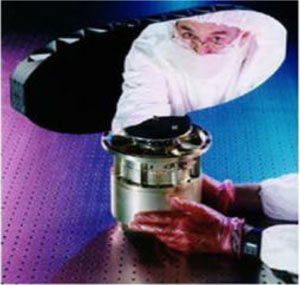
The entire Scan Mirror assembly weighs 4.3 kilograms. Although a number of materials were considered for the Scan Mirror's composition (including ULE, Zerodur, silicon carbide, aluminum, foamed beryllium, HIP beryllium, and various metal matrices), HIP beryllium and electroless nickel were chosen because HIP beryllium has a superior stiffness-to-weight ratio, a high-precision elastic limit, and provides an excellent match of CTE with electroless nickel. The mirror itself was constructed using the wire EDM technique to keep it lightweight, was nickel-plated, coated in silver, and finished with a protective layer.
In addition to designing a near-perfect double-sided mirror, the scientists also had to design a motor to turn it smoothly so that each pass of the mirror collected data in the same way as previous passes (no variation of data due to the speed of rotation, movement of the mirror, etc.). They came up with a 14-bit incremental optical encoder coupled to a redundantly wound 16-pole 2-phase brushless DC motor that turns the mirror smoothly at 20.3 rpm, has cogging torque of less than 3.6 ounces per inch, and a torque ripple of less than ten percent. The maximum mirror power at the operational speed of 20.3 rpm and full torque (30 oz/in) is only one watt. The rotating parts are balanced to meet the spacecraft requirement of 0.3 kg per mm, and the 14-bit optical encoder demonstrated 11-microradian accuracy. The optical encoder's read heads consist of an LED, collimating lenses, a reticle, and a photodiode array. The fiber-optic type LEDs produce a 0.01-inch diameter spot that allows excellent collimation. The encoder itself requires a total of 1.9 watts of power.
