

Solar Diffuser
Description
The Solar Diffuser calibrates MODIS reflective bands. By knowing the reflectance properties of the Diffuser’s surface and the sun’s angle when radiation strikes it, MODIS scientists are able to predict the radiance of the diffuser, thereby providing a source for the absolute radiometric calibration of the reflective bands. Measuring photons coming directly from the Sun will enable engineers on the ground to calibrate the responsiveness of the entire MODIS system. Since the Sun has a constant output, any change in MODIS output must be due to degradation of either MODIS itself or the Solar Diffuser. And because the Solar Diffuser has an attenuating screen, it is also able to provide two different effective albedo levels (the amount of light reflected by a surface).
Technical Description
Sunlight strikes the Solar Diffuser once per orbit (at the North Pole for Terra and the South Pole for Aqua). Data are collected when the instrument is on the dark side of the terminator, which limits the level of stray light entering MODIS via the Earth View port.
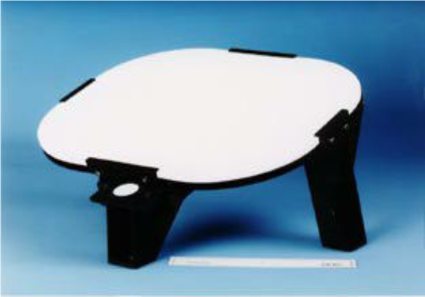
The accompanying image shows the Solar Diffuser assembly complete with its pre-flight contamination witness sample assembly. The diffuse surface is made from space-grade carbon-loaded Spectralon (manufactured by Labsphere in North Sutton, NH), which is a proprietary thermoplastic formulation of polytetraflouroethylene (PTFE). Spectralon was chosen because of its controlled reflectance in the VIS-NIR-SWIR region, its near-Lambertian reflectance profile, and its compatibility with the space environment.
