



On-Board Calibration System
Description
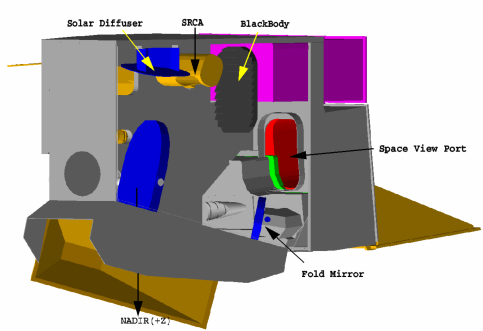
The MODIS instrument has a full complement of On-Board Calibrators (OBCs) that generate various stimuli to provide radiometric, spectral, and spatial calibration for various MODIS components. The four OBCs are the Blackbody (BB), the Solar Diffuser (SD), the Solar Diffuser Stability Monitor (SDSM), and the Spectroradiometric Calibration Assembly (SRCA). There are also two other calibration techniques, explained below.
Technical Description
The Blackbody is the prime calibration source for the mid- and long-wave infrared bands (located from 3.5 µm to 14.4 µm), while the Solar Diffuser provides a diffuse, solar-illuminated calibration source for the visible, near infrared, and short-wave infrared bands (0.4 µm < = lambda < = 2.2 µm). The SDSM tracks changes in the reflectance of the SD via reference to the sun so that potential instrument changes are not incorrectly attributed to changes in the calibration source. The SRCA is a complex, multi-function calibration instrument that provides in-flight spectral, radiometric, and spatial calibration.
In addition to the dedicated calibration components above, MODIS has two additional calibration techniques: looking at the Moon and deep space. The advantage of looking at the Moon is that it enables MODIS to view an object that is roughly as bright as the Earth. Like the on-board Solar Diffuser, the Moon is illuminated by the Sun; however, unlike the Solar Diffuser or the Earth, the Moon is not expected to change over the lifetime of the MODIS mission. Looking at the moon provides a second method for tracking degradation of the Solar Diffuser. Meanwhile, looking at deep space provides a photon input signal of zero, which will be used as an additional point of reference for calibration. The difference between the actual value of zero and what MODIS “sees” will tell scientists how much the data need to be adjusted in compensation.
