

Images
February 28, 2025 - Prescribed burns in Ouachita National Forest
 Tweet
Tweet
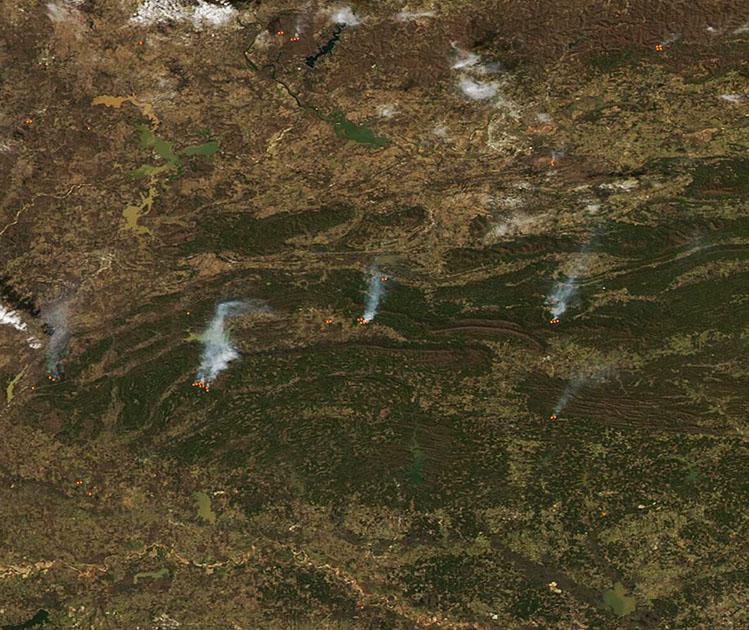
Smoke billowed from several small fires in the Ouachita Mountains on February 25, 2025, when the Moderate Resolution Imaging Spectroradiometer (MODIS) on NASA’s Aqua satellite acquired this true-color image.
Each red “hot spot” marks an area where the thermal bands on the MODIS instrument detected high temperatures. When accompanied by typical smoke—as in most of the hot spots in this image—they are diagnostic for actively burning fire. The heaviest smoke pours from two fires in Arkansas (east) and substantial smoke also rises from three hot spots in Oklahoma (west). Multiple smaller hot spots dot the landscape of Oklahoma.
The U.S. Forest Service —Ouachita National Forest has published advice to the public announcing that it is performing prescribed burns within the forest this week. Given there are no reports of wildfires in the region, it’s a safe bet that all of these fires are prescribed burns.
Prescribed burns are fires that are deliberately set and contained in order to manage wildland. According to the Ouachita National Forest website, “Since the beginning of time, fires have burned in the forests of Arkansas and Oklahoma, playing a vital role in keeping the land healthy. Fire reduces dead vegetation, replenishes nutrients in the soil, stimulates new growth, and maintains biological diversity.”
Prescribed burns are typically performed in late winter and early spring in this region, although some are held in early winter. It is essential that vegetation is not too thick or too dry, and that little wind is anticipated during the burn. It is also helpful to have relatively low temperatures and high humidity. All these factors make it easier to control fire, to keep it from getting out of control and becoming a wildfire.
Image Facts
Satellite:
Aqua
Date Acquired: 2/25/2025
Resolutions:
1km (64.4 KB), 500m (175.8 KB), 250m (354.2 KB)
Bands Used: 1,4,3
Image Credit:
MODIS Land Rapid Response Team, NASA GSFC
Smoke billowed from several small fires in the Ouachita Mountains on February 25, 2025, when the Moderate Resolution Imaging Spectroradiometer (MODIS) on NASA’s Aqua satellite acquired this true-color image.
Each red “hot spot” marks an area where the thermal bands on the MODIS instrument detected high temperatures. When accompanied by typical smoke—as in most of the hot spots in this image—they are diagnostic for actively burning fire. The heaviest smoke pours from two fires in Arkansas (east) and substantial smoke also rises from three hot spots in Oklahoma (west). Multiple smaller hot spots dot the landscape of Oklahoma.
The U.S. Forest Service —Ouachita National Forest has published advice to the public announcing that it is performing prescribed burns within the forest this week. Given there are no reports of wildfires in the region, it’s a safe bet that all of these fires are prescribed burns.
Prescribed burns are fires that are deliberately set and contained in order to manage wildland. According to the Ouachita National Forest website, “Since the beginning of time, fires have burned in the forests of Arkansas and Oklahoma, playing a vital role in keeping the land healthy. Fire reduces dead vegetation, replenishes nutrients in the soil, stimulates new growth, and maintains biological diversity.”
Prescribed burns are typically performed in late winter and early spring in this region, although some are held in early winter. It is essential that vegetation is not too thick or too dry, and that little wind is anticipated during the burn. It is also helpful to have relatively low temperatures and high humidity. All these factors make it easier to control fire, to keep it from getting out of control and becoming a wildfire.
Image Facts
Satellite:
Aqua
Date Acquired: 2/25/2025
Resolutions:
1km (64.4 KB), 500m (175.8 KB), 250m (354.2 KB)
Bands Used: 1,4,3
Image Credit:
MODIS Land Rapid Response Team, NASA GSFC


