

Images
September 12, 2025 - Colors in the Caspian Sea
 Tweet
Tweet
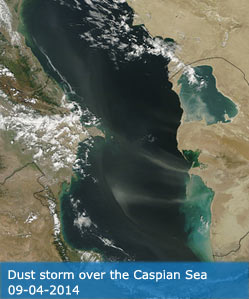
Brilliant colors filled the southern Caspian Sea in early September 2025. The Moderate Resolution Imaging Spectroradiometer (MODIS) on NASA’s Aqua satellite captured this true-color image of swirling greens and blues on September 3.
The colors were created by a mix of suspended sediment and floating phytoplankton, which are microscopic plant-like organisms. When conditions are favorable, phytoplankton can reproduce explosively to create large “blooms” that are easily visible from space.
While it’s not possible to know with certainty what type of phytoplankton are in a bloom from satellite imagery alone, the milky-blue blooms seen in this image are most likely caused by coccolithophores, a type of phytoplankton that surround themselves with microscopic plating made of calcite. These plates, known as coccoliths, are shaped like hubcaps and are only three one-thousandths of a millimeter in diameter. At any one time, a single coccolithophore is attached to or surrounded by at least 30 scales. When massed together in large numbers, these scales give the bloom a milky turquoise color.
The green tint surrounding the sandy shoreline may also contain a different species of phytoplankton, but the color is most likely caused by suspended sediment that has been washed or blown into the near-shore waters. Sediment appears brown or tan when floating right at the surface. However, when the sediment begins to sink below the surface, its reflectivity changes and that means the color also changes. As sediment sinks, it first appears green then, as it falls to deeper levels, will darken and may appear blue before it completely sinks out of sight.
Image Facts
Satellite:
Aqua
Date Acquired: 9/3/2025
Resolutions:
1km (279.3 KB), 500m (769 KB), 250m (1.5 MB)
Bands Used: 1,4,3
Image Credit:
MODIS Land Rapid Response Team, NASA GSFC
Brilliant colors filled the southern Caspian Sea in early September 2025. The Moderate Resolution Imaging Spectroradiometer (MODIS) on NASA’s Aqua satellite captured this true-color image of swirling greens and blues on September 3.
The colors were created by a mix of suspended sediment and floating phytoplankton, which are microscopic plant-like organisms. When conditions are favorable, phytoplankton can reproduce explosively to create large “blooms” that are easily visible from space.
While it’s not possible to know with certainty what type of phytoplankton are in a bloom from satellite imagery alone, the milky-blue blooms seen in this image are most likely caused by coccolithophores, a type of phytoplankton that surround themselves with microscopic plating made of calcite. These plates, known as coccoliths, are shaped like hubcaps and are only three one-thousandths of a millimeter in diameter. At any one time, a single coccolithophore is attached to or surrounded by at least 30 scales. When massed together in large numbers, these scales give the bloom a milky turquoise color.
The green tint surrounding the sandy shoreline may also contain a different species of phytoplankton, but the color is most likely caused by suspended sediment that has been washed or blown into the near-shore waters. Sediment appears brown or tan when floating right at the surface. However, when the sediment begins to sink below the surface, its reflectivity changes and that means the color also changes. As sediment sinks, it first appears green then, as it falls to deeper levels, will darken and may appear blue before it completely sinks out of sight.
Image Facts
Satellite:
Aqua
Date Acquired: 9/3/2025
Resolutions:
1km (279.3 KB), 500m (769 KB), 250m (1.5 MB)
Bands Used: 1,4,3
Image Credit:
MODIS Land Rapid Response Team, NASA GSFC


