

Images
February 2, 2026 - Dust over the Persian Gulf
 Tweet
Tweet
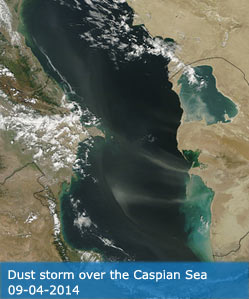
Dust blew southward across the Persian Gulf in late January 2026, tinting the skies tan. At the same time, a heavy sediment burden colored the near-shore waters both tan and green. Suspended sediment near the surface appears tan but the reflectivity of sediment—and its appearance—changes as it sinks, so sediment below the surface often looks green. An abundance of phytoplankton, which are chlorophyll-containing plant-like microscopic organisms, may also be lending a green tone to the Persian Gulf.
Dust storms are common in this region, even in winter when, theoretically, strong shamal winds tend to be less frequent. This image, acquired on January 30 by the Moderate Resolution Imaging Spectroradiometer (MODIS) on NASA’s Terra satellite, actually shows the clearest skies during the last week.
Strong winds can and do occur any time of the year, even in winter, and they are the most frequent cause of dust storms in the region. Other than wind-driven events, natural and human sources add to the region’s burden of aerosols. According to IQAir, salt blow in from the sea, rapid-paced construction, and vehicle and petrochemical industrial emissions all contribute to wintertime air pollution. Temperature inversions—when a layer of warm air sits above cooler air near the surface—can trap pollutants close to the ground. This keeps skies hazy for longer periods of time and can increase airborne particulate matter to unhealthy levels for people and animals.
Image Facts
Satellite:
Terra
Date Acquired: 1/30/2025
Resolutions:
1km (176.5 KB), 500m (411.2 KB), 250m (577.7 KB)
Bands Used: 1,4,3
Image Credit:
MODIS Land Rapid Response Team, NASA GSFC
Dust blew southward across the Persian Gulf in late January 2026, tinting the skies tan. At the same time, a heavy sediment burden colored the near-shore waters both tan and green. Suspended sediment near the surface appears tan but the reflectivity of sediment—and its appearance—changes as it sinks, so sediment below the surface often looks green. An abundance of phytoplankton, which are chlorophyll-containing plant-like microscopic organisms, may also be lending a green tone to the Persian Gulf.
Dust storms are common in this region, even in winter when, theoretically, strong shamal winds tend to be less frequent. This image, acquired on January 30 by the Moderate Resolution Imaging Spectroradiometer (MODIS) on NASA’s Terra satellite, actually shows the clearest skies during the last week.
Strong winds can and do occur any time of the year, even in winter, and they are the most frequent cause of dust storms in the region. Other than wind-driven events, natural and human sources add to the region’s burden of aerosols. According to IQAir, salt blow in from the sea, rapid-paced construction, and vehicle and petrochemical industrial emissions all contribute to wintertime air pollution. Temperature inversions—when a layer of warm air sits above cooler air near the surface—can trap pollutants close to the ground. This keeps skies hazy for longer periods of time and can increase airborne particulate matter to unhealthy levels for people and animals.
Image Facts
Satellite:
Terra
Date Acquired: 1/30/2025
Resolutions:
1km (176.5 KB), 500m (411.2 KB), 250m (577.7 KB)
Bands Used: 1,4,3
Image Credit:
MODIS Land Rapid Response Team, NASA GSFC


